The theoretical framework
Urie Bronfenbrenner's bioecological theory is one of the most widely used frameworks in developmental science. It positions development as something that happens through ongoing interactions between a person and the nested environments around them, from the immediate settings of daily life to the broader cultural and historical forces.
But Bronfenbrenner built his model before the internet. The microsystem, the most proximal context, was always assumed to be a physical, or face-to-face setting. What happens when some of the most significant interactions in a person's life take place online?
Neo-ecological theory answers that question. Building on Bronfenbrenner's foundation, it formally adds a virtual microsystem alongside the physical microsystem, recognizing that digital environments are not just tools or distractions. They are genuine developmental contexts with their own affordances, objects, symbols, and unique relationships, and are one of the most ubiquitous contexts in which we now work, play, and learn.
This framework guides my empirical work on families, technology, and development, and shapes how I teach, consult, and speak about these questions with researchers, practitioners, and the public.
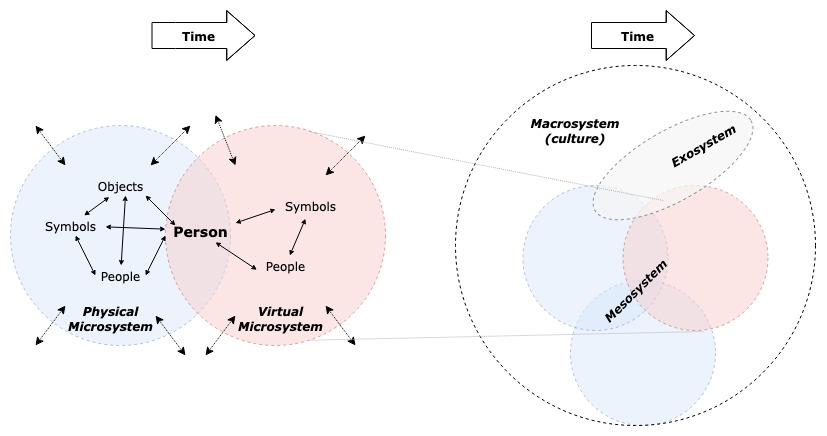 Neo-ecological theory (Navarro & Tudge, 2022)
AI & Human Development
- Integrating AI into neo-ecological theory and developmental science
- AI in social work and human service practice
- Smartphone use and adolescent mental health
Global & International
- Forthcoming · Palgrave Macmillan Reframing Costa Rica: An Anthology of Counter-Stories and Critical Perspectives
- Cross-national applications of neo-ecological theory in youth development
- Global reflection pedagogy and study abroad
Pedagogy & Theory
- Neo-ecological theory in sport science and positive youth development
- Research methods pedagogy and AI literacy
- Curriculum development in human service studies
Navarro, J., & Tudge, J. R. H. (2022). Technologizing Bronfenbrenner: Neo-ecological theory. Current Psychology. https://doi.org/10.1007/s12144-022-02738-3
Highly Cited Paper · 585 citations · 67,000+ downloads-
2026
Navarro, J. (2026). Integrating AI into neo-ecological theory. Current Psychology, 45(505). https://doi.org/10.1007/s12144-025-09006-0
-
 2025
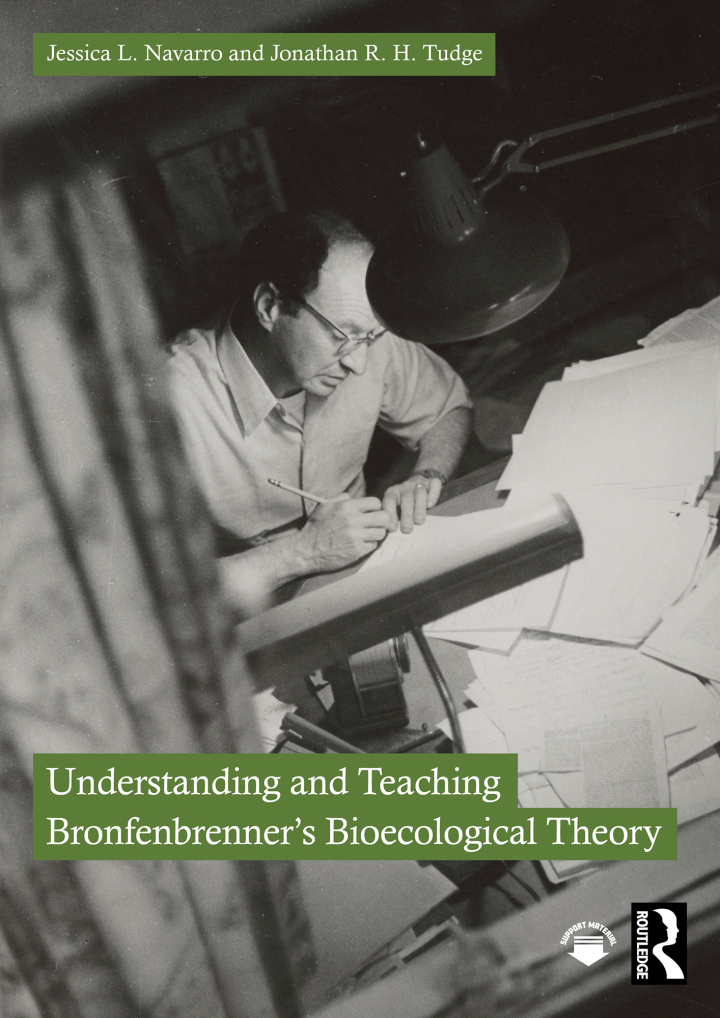
2025Navarro, J., & Tudge, J. R. H. (2025). Understanding and Teaching Bronfenbrenner's Bioecological Theory. Routledge.
Get the book on Amazon → -
2025
Navarro, J., & Jensen, M. (2025). Styles of digital parental mediation: A multi-group person-centered approach. Journal of Child and Family Studies. Advance online publication. https://doi.org/10.1007/s10826-025-03229-2
-
2025
Capraro, V., Globig, L., Rausch, Z., Rathje, S., Wormley, A., Olson, J., Ross, R., Aşçı, S., Bouguettaya, A., Burnell, K., Choukas-Bradley, S., Fardouly, J., Kowert, R., Lopez, R., Maheux, A., Mirea, D.-M., Ozimek, P., Selterman, D., Thiagarajan, T., … Navarro, J., … Haidt, J., & Van Bavel, J. J. (2025). A consensus statement on potential negative impacts of smartphone and social media use on adolescent mental health. Seton Hall Law School Legal Studies Research. https://doi.org/10.2139/ssrn.5256747
-
2024
Navarro, J. L., Brown, M., Jensen, T., Weinstein, M., & Jensen, M. (2024). It isn't just Mom: Gendered provision of family and home responsibilities among emerging adults during COVID-19. Frontiers in Psychiatry, 15, 1330424. https://doi.org/10.3389/fpsyt.2024.1330424
-
2024
Chase, G. E., Brown, M. T., Navarro, J. L., Lippold, M. A., & Jensen, M. (2024). Digital location tracking in the parent/caregiver–college student dyad. Journal of Adolescence. https://doi.org/10.1002/jad.12300
-
2023
Jensen, M., Navarro, J. L., Brown, M., & Hussong, A. (2023). Dyadic parent–college student interaction styles. Journal of Family Psychology, 37(6), 864–874. https://psycnet.apa.org/doi/10.1037/fam0001117
-
2022
Navarro, J., Stephens, C., Rodrigues, B. C., Walker, I. A., Cooke, O., O'Toole, L., Hayes, N., & Tudge, J. R. H. (2022). Bored of the rings: Methodological and analytic approaches to operationalizing Bronfenbrenner's PPCT model in research practice. Journal of Family Theory & Review, 14(2), 233–253. https://doi.org/10.1111/jftr.12459